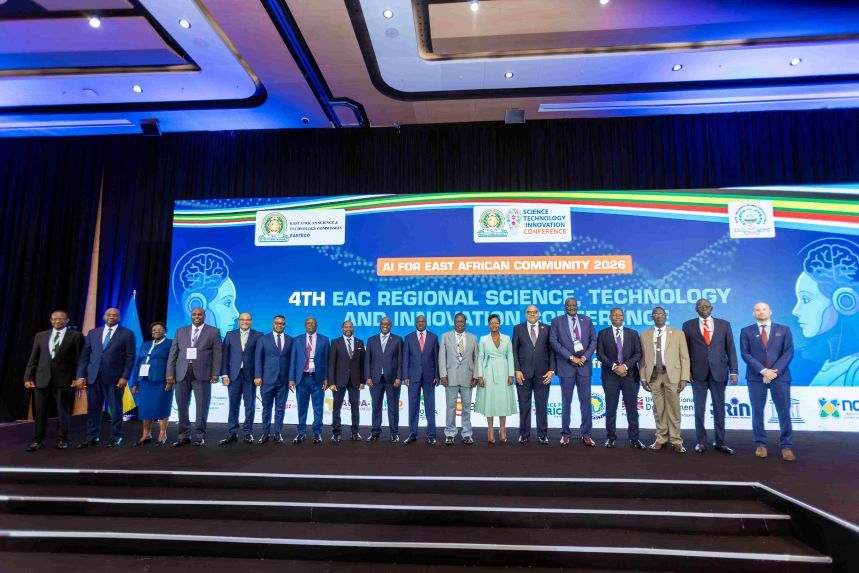
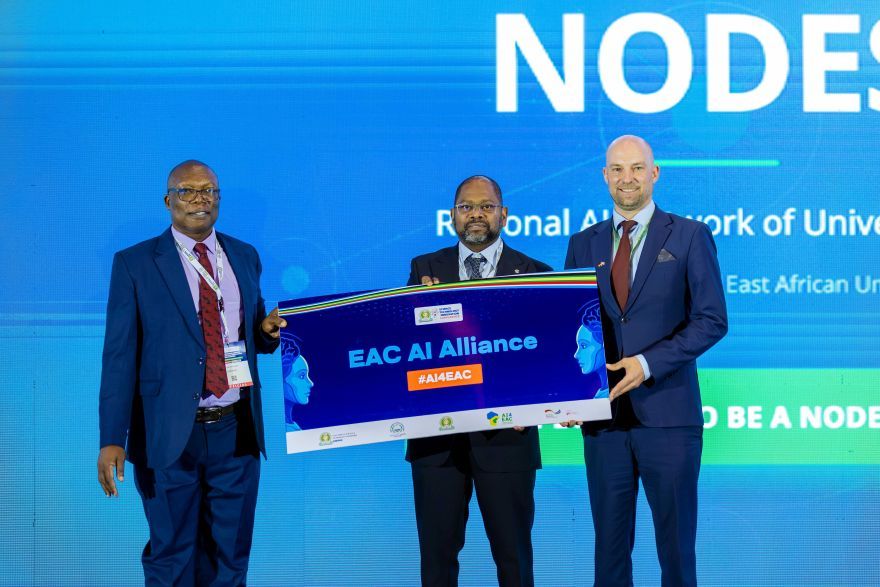
The 4th East African Community Regional Science, Technology and Innovation (STI) Conference opened on Monday, 30 March 2026, at the Kigali Convention Centre with a milestone announcement that signals a new chapter in the region’s digital future: the formal launch of the EAC AI Alliance and its inaugural flagship initiative, the Regional Network on Artificial Intelligence in Education and Research.
Convened under the theme “Harnessing Artificial Intelligence for a Resilient, Inclusive and Innovative East Africa,” the three-day conference brings together more than 450 delegates, policymakers, researchers, innovators, industry leaders and development partners, from all eight EAC Partner States. It is the first edition of the biennial STI Conference in which Artificial Intelligence has taken centre stage as the driver of the agenda. Day One set the tone with clarity: Africa must move from consuming technology to creating it. That imperative — repeated across opening addresses, keynotes and panel sessions alike — framed everything that followed, including the afternoon’s landmark launches.
A COORDINATED REGIONAL AI AGENDA
The EAC AI Alliance was presented as the region’s answer to a persistent structural challenge: fragmented national efforts that have limited the scale and impact of AI investment across the Partner States. Rather than eight countries each navigating the AI landscape independently, the Alliance proposes a shared architecture, uniting governments, academia, industry, and development partners under a common regional framework. Andrea Aguer Ariik Malueth, Deputy Secretary General of the East African Community, described the Alliance as a decisive turning point, noting that it marks a shift from fragmented efforts to structured, scalable regional action.
The Alliance builds directly on the legacy of the dSkills@EA project, the EAC’s three-year digital skills initiative implemented by IUCEA and GIZ, which trained more than 4,000 young East Africans and built cooperation ecosystems engaging over 300 private sector partners and 100 universities. Where dSkills@EA laid the foundation, the EAC AI Alliance is designed to scale the architecture.
A CALL TO UNIVERSITIES: BECOME A NODE
The centrepiece announcement of the morning session was the launch of the Call for Nodes for the Regional AI Network — an open invitation to universities across the eight EAC Partner States to apply as national anchors within a distributed, cross-border network designed to strengthen AI education, research, and innovation at institutional level.
Prof. Idris Rai, Acting Executive Secretary of the Inter-University Council for East Africa (IUCEA), set out the stakes.
“Artificial Intelligence offers a transformative opportunity to accelerate socio-economic development, strengthen public service delivery, and enhance regional competitiveness across the East African Community. Realising this potential requires deliberate coordination among higher education institutions, research bodies, industry and policymakers, supported by shared resources and a coherent regional vision.” Prof. Idris Rai, Acting Executive Secretary, IUCEA.
IUCEA, in collaboration with EASTECO and GIZ through the EAC AI Alliance project, is establishing the Regional AI Network. The Call for Expressions of Interest invites universities to serve as national nodes — institutional hubs that will anchor cross-border AI research ecosystems, support the development of a future-ready workforce, and promote responsible and inclusive AI deployment across key sectors.
The Regional AI Network is designed as the foundation for a still larger ambition: the establishment of an East African Centre of Excellence in AI. The goal, as articulated by conference organisers, is to position the region not merely as a consumer of emerging technologies, but as a competitive global contributor.
The Network’s work will be structured around three pillars: advancing cross-border AI research to address shared regional challenges; integrating inclusive, practice-based AI curricula to equip learners with industry-relevant skills; and supporting harmonised, gender-responsive policies for responsible AI adoption.
SKILLS, NOT JUST TECHNOLOGY
Norman Schappel, Digital Transformation Cluster Coordinator at GIZ Rwanda, offered the day’s most grounding perspective, one that resonated strongly across the room.
“AI is not a technology fix. It will not solve our problems. It is based on how we use the technology and build the skills with AI to solve challenges in the East African Community.” Norman Schraepel, Cluster Coordinator, GIZ Rwanda.
The sentiment echoed a central thread from Day One’s broader proceedings: that the region has strong research talent but must dramatically strengthen the pathways from research to commercialisation and real-world deployment. Speakers throughout the day called for stronger innovation hubs, dedicated funding mechanisms, and deeper industry-university partnerships to close that gap.
DIGITAL LEADERS FORUM AND THE REGIONAL AI STRATEGY
The Conference hosted the inaugural Digital Leaders Forum on AI, a strategic platform convening senior digital policymakers and institutional leaders from across the Partner States. The Forum focused on three specific priorities: refining the Draft EAC Regional AI Strategy; introducing a Digital Transformation Governance Structure for coordinating regional AI leadership; and strengthening alignment on policy, infrastructure, and investment. The emphasis throughout was on coherence, ensuring that national initiatives, however well-designed individually, collectively advance regional objectives rather than pulling in different directions.
AI4EAC INNOVATION CHALLENGE: EAST AFRICA’S YOUNG BUILDERS
The Conference also celebrated homegrown innovation through the AI4EAC Innovation Challenge, a flagship initiative of the EAC AI Alliance that has engaged over 3800 students from 110 universities across all eight EAC Partner States. The Challenge, run in partnership with Zindi, UNESCO Campus Africa, JICA and other partners, culminated in a final weekend on 28–29 March, just days before this conference opened. Prizes won among others are $30,000 in cash prize, internships, mentorship, credentials and compute resources.
Finalists showcased locally developed AI solutions in healthcare diagnostics, crop yield prediction, climate resilience, financial inclusion, and public service delivery — demonstrating that the region’s next generation of builders is already well underway. The participation of young innovators and startups across all eight Partner States was cited repeatedly by senior speakers as the most compelling evidence that the EAC’s AI ambitions are not aspirational — they are already being built from the ground up.
The implementation of the Regional AI Strategy, the operationalisation of the Network’s national nodes, and the work of the Digital Leaders Forum will determine how quickly that decision becomes reality.