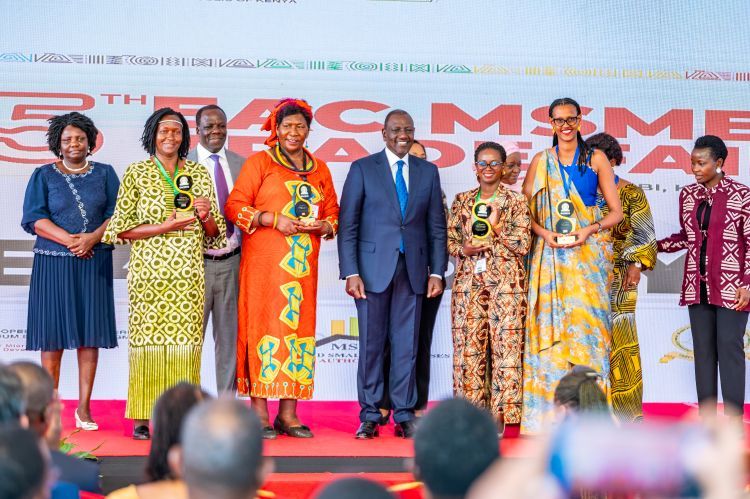
Elizabeth Ngina Muasya’s entrepreneurial journey is a compelling story of resilience, adaptability, and a deep commitment to advancing women’s economic empowerment. As Director of Shalom Pride Collection Association and a former Member of County Assembly in Machakos County, Kenya, she has spent over three decades navigating the intersections of informal trade, formal retail, export markets, and public leadership.
Through her work, she has successfully transformed grassroots skills into globally traded products while championing the inclusion of women traders in policy and governance spaces.
Elizabeth’s journey began in 1990 when she trained as a dressmaker and launched a small tailoring business in Nairobi’s Ngara market. Operating in a highly competitive informal environment, she quickly built a reputation for quality and reliability. This enabled her to secure supply contracts with major retail chains such as Uchumi Supermarket - an uncommon achievement for a young woman entrepreneur transitioning from informal production into formal retail at the time.
In 1998, Elizabeth diversified into agricultural trade, sourcing bananas from Uganda and supplying supermarkets including Uchumi and Nakumatt. This marked her early engagement in cross-border trade within the East African region, long before regional integration frameworks became widely operational. However, the collapse of Uchumi in 2004 disrupted her business model, exposing the risks of overdependence on large retail outlets and forcing her to reassess her strategy.
Rather than retreat, she pivoted. Returning to tailoring while exploring new market opportunities through the Export Promotion Council, Elizabeth identified a significant gap: rural women artisans possessed valuable weaving skills but lacked access to structured markets. This insight led to the formation of Shalom Pride Collection Association between 2004 and 2006, an initiative that would evolve from a modest community effort into a thriving enterprise.
Ethical manufacturing, livelihoods and export growth
Today, Shalom Pride stands as a leading women-led manufacturing enterprise in Kenya’s craft sector. The association produces high-quality baskets made from sisal, banana fibre, raffia, and reeds, blending traditional craftsmanship with export standards. Raw materials are sourced locally from Machakos, Makueni, and Kitui counties, with raffia imported from Uganda, firmly embedding the enterprise within regional value chains.
The association works with over 200 women artisans organized into 32 groups, providing consistent income opportunities in communities often excluded from formal employment.
Supported by 18 staff members handling quality control, packaging, and logistics, Shalom Pride maintains steady operations and compliance with buyer requirements. With an annual turnover of approximately KES 5 million, the enterprise generates income through both custom export orders and ready-for-market products.
A defining feature of Elizabeth’s leadership is her role as a market intermediary, translating international buyer requirements into practical production guidelines for artisans. This approach enables women to participate more effectively in value chains, enhancing their understanding of pricing, quality standards, and delivery timelines while reducing reliance on intermediaries.
The association’s first major international breakthrough came in 2006 at an exhibition in New York, which opened access to European markets and validated the global potential of Kenyan crafts. Since then, Shalom Pride has partnered with institutions such as Ethical Fashion Germany and the Kenya Export Promotion and Branding Agency, strengthening its compliance with ethical sourcing and traceability standards.
EAC integration and policy engagement
Elizabeth’s work is closely aligned with regional integration efforts. Her cross-border sourcing, participation in trade exhibitions, and engagement with export promotion institutions reflect the practical benefits of East African trade frameworks. However, she continues to highlight persistent challenges, including high compliance costs, inconsistent standards enforcement, and limited access to affordable finance for women-led enterprises.
These challenges motivated her entry into public service. In 2008, she served as a councillor representing women in business, advocating for improved market access and trader inclusion. From 2013 to 2017, she served as a Member of County Assembly in Machakos, where she championed women-responsive enterprise policies, better market infrastructure, and recognition of informal traders within county planning systems. Her experience reinforced the link between economic empowerment and effective governance.
Digital futures and ethical trade as development pathways
At its core, Shalom Pride’s story is one of transformation. What began in 2002 as a community support initiative for vulnerable groups evolved into a sustainable, skills-based enterprise model. By shifting from charity to structured economic participation, the association has created lasting livelihoods rooted in dignity and self-reliance.
Recognition as an East African Woman in Trade Champion under LIFTED – a project jointly co-financed by the German Federal Ministry for Economic Cooperation and Development (BMZ) and the European Union (EU) gave a new focus for Elizabeth including expansion into digital trade, pursuing eco-certification, and strengthening regional artisan networks. She envisions a future where marginalized producers are fully integrated into transparent and ethical value chains that meet global standards.
Her journey - from market stalls to international exhibitions, and from grassroots organizing to legislative leadership demonstrates the transformative potential of women-led enterprise.
Through Shalom Pride Collection Association, Elizabeth Ngina Muasya has not only built a successful business but also contributed meaningfully to inclusive trade, regional integration, and sustainable economic development.