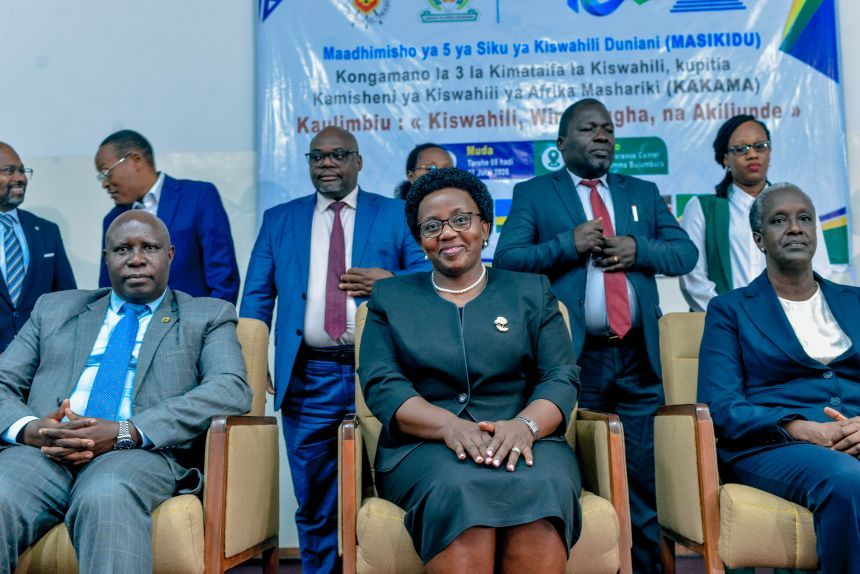
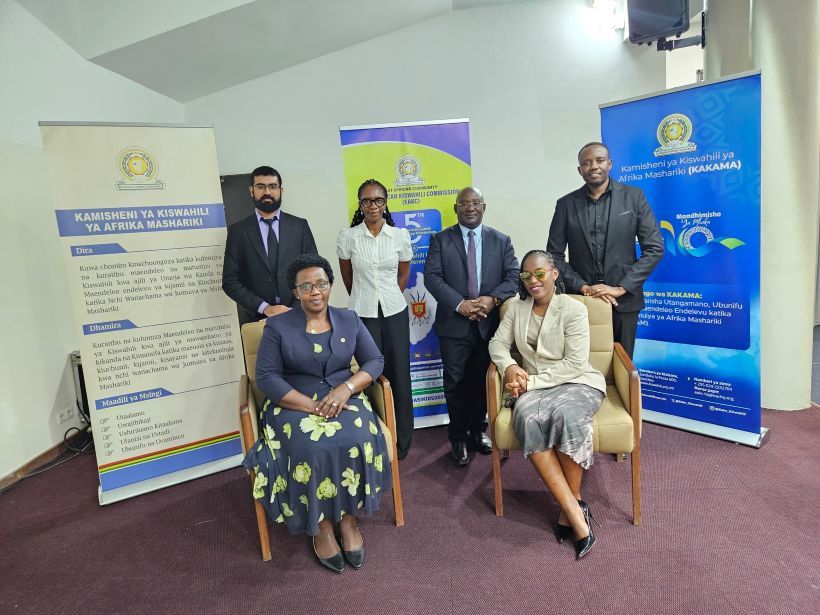
On 7 July 2026, the East African Kiswahili Commission (EAKC) marked the 5th EAC World Kiswahili Language Day Celebrations at Jardin Public in Bujumbura, under the theme “Kiswahili, Multilingualism, and Artificial Intelligence (AI)”.
Building on the 2026 UNESCO World Kiswahili Language Day theme, "Kiswahili for Peace, Solidarity and Global Economic Diplomacy," the EAKC theme affirms that as AI reshapes global communication, Kiswahili must become a digitally empowered African language that strengthens multilingual inclusion, fosters peace and solidarity, and advances regional integration and global economic diplomacy.
The celebrations were attended by the Chief Guest, Hon. Lydia Nsekera, Minister of Youth, Sports and Culture of Burundi, representing H.E. Évariste Ndayishimiye, President of the Republic of Burundi and Chairperson of the African Union, alongside other high-level dignitaries, including Hon. James Ikuya, representing the Chairperson of the EAC Council of Ministers; Hon. Edouard Bizimana, Minister for Foreign Affairs, Regional Integration and Development Cooperation; Rt. Hon. Joseph Ntakirutimana, Speaker of the East African Legislative Assembly; Hon. Nestor Kayobera, Judge President of the East African Court of Justice; Heads of EAC Partner State Delegations; representatives of diplomatic missions, UNESCO and development partners, among others.
In her remarks, Hon. Lydia Nsekera noted that Kiswahili needs to be given a high value as a language of unity, peace and economic diplomacy for East Africa, and highlighted Burundi’s pride in hosting the region as it advances Kiswahili’s digital future.
The celebrations followed two days of deliberations at the 3rd EAKC International Kiswahili Conference, held from 5 to 6 July 2026 at the Donatus Conference Centre in Bujumbura, which brought together policymakers, scholars, technologists, youth, publishers and development partners from across the EAC Partner States and beyond. The Conference examined how Kiswahili, spoken by an estimated more than 250 million people, and East Africa’s rich multilingual heritage can be fully embedded in the AI systems that are reshaping education, public services, trade and innovation, so that no language and no community is left behind in the digital economy.
A key outcome of the event was the joint commitment of EAC Partner States on Kiswahili, Multilingualism and AI, through which the region commits to treating Kiswahili as a strategic component of its digital infrastructure. The EAC Partner States called for a regional roadmap for digitising East African languages, shared open language datasets and corpora, a sustained mechanism for standardising Kiswahili AI terminology, expanded scholarships and university collaboration, and African ownership of the language data that powers AI systems.
Through the EAC AI Alliance, the Commission in partnership with GIZ also announced the commencement of work on the Kiswahili Trust Mark (Alama ya Uthibitisho wa Kiswahili), a regional certification framework that will independently assess and certify how well AI language models understand, speak and serve Kiswahili. The Trust Mark will evaluate systems against standards of linguistic quality, terminological accuracy, cultural context and safety, and will be supported by a public register of certified AI systems giving governments, schools, businesses and citizens confidence in the AI tools they adopt. Stakeholder consultations involving regional and global institutions such as Google, PAWA AI, councils for Kiswahili in Tanzania and Zanzibar, launched at the Conference, will shape the framework over the coming year.
In a major boost to Kiswahili scholarship and knowledge production, a scholarly journal, Jarida la KAKAMA, a new peer-reviewed Kiswahili journal published by the East African Kiswahili Commission, was launched. Jarida la KAKAMA will provide a rigorous platform for scholars, practitioners and creatives to publish original research, essays and reviews in Kiswahili, strengthening its role as a language of science, technology, innovation and regional integration.
EAKC, in collaboration with Google, unveiled a new compendium of Kiswahili AI terminologies developed in collaboration with UNESCO, BAKITA, BAKIZA, TATAKI and other partners, which stakeholders are expected to review and provide comments on. This adds to the UNESCO-supported English–Kiswahili AI dictionary initiative launched last year, a milestone in ensuring that the language of artificial intelligence can be taught, debated and innovated in Kiswahili.
Dr Caroline Asiimwe, Executive Secretary, East African Kiswahili Commission, stated that, “Technology must not leave African languages behind; Kiswahili will not merely keep pace with the digital revolution but help lead it.” She emphasised that AI could become a powerful tool for preserving and promoting Kiswahili, provided it is built on high-quality, locally relevant language data. "AI models must reflect the richness and evolving nature of Kiswahili," she added.
In addition, in a bid to support the development and use of Kiswahili and media resilience, EAKC announced the launch of the translated Model Disaster Preparedness and Response Plan for Media Institutions developed by UNESCO and translated into Kiswahili by EAKC and stakeholders. This model plan will be accessible to Kiswahili-speaking media houses to strengthen disaster risk preparedness, crisis communication and continuity planning, ensuring that journalists and media institutions can continue to inform citizens in times of emergency.
The outcomes of these events build on growing regional cooperation on artificial intelligence, including initiatives under the EAC Declaration on Artificial Intelligence adopted in Kigali in April 2026 and the EAC AI Alliance, and will be pursued together with EAC organs and institutions, among them the East African Science and Technology Commission (EASTECO), the Inter-University Council for East Africa (IUCEA), the East African Development Bank (EADB), the Lake Victoria Basin Commission (LVBC), as well as UNESCO, development partners and the private sector.