The East African Community is moving towards establishing foundational Artificial Intelligence (AI) literacy as a common component of higher education across the region, equipping students across disciplines with the knowledge and practical skills needed support regional mobility while strengthening graduate capacities to navigate an increasingly AI-enabled world of work.
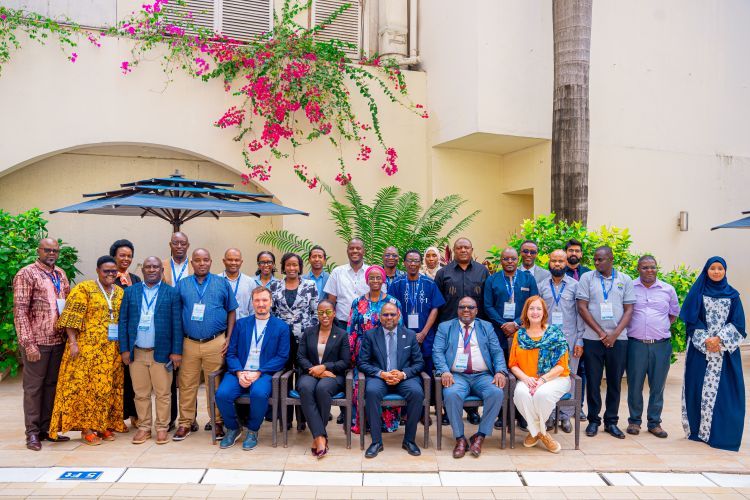
As part of this agenda, the EAC, through the Inter-University Council for East Africa (IUCEA), in cooperation with GIZ on behalf of the German Federal Ministry for Economic Cooperation and Development (BMZ), convened a regional stakeholder engagement workshop in Dar es Salaam to validate the draft AI Foundational Module, co-developed in consultation with experts from EAC Partner States and private sector. The two-day engagement, held from 6 to 7 October 2026, brought together stakeholders from higher learning institutions, AI experts, government and regulatory institutions, development partners to assess the module’s relevance, quality, practical applicability and readiness for implementation across the region.
The AI Foundational Module is being developed as a context-responsive East African resource, drawing on international benchmarks while responding to the region’s educational, technological, institutional and socio-economic realities. The co-creation approach places East African higher learning institutions, educators and learners at the centre of developing a common foundation for AI literacy and practical application.
Speaking at the opening of the workshop, Acting Executive Secretary of IUCEA, Professor Idris Rai, emphasised the need for the region to develop its own AI skills base rather than rely solely on solutions developed elsewhere. “Our ambition is not simply to adopt what has been developed elsewhere. We want to co-create a foundational AI module that reflects the context of East Africa and equips our youth with the knowledge and practical capabilities they need to engage meaningfully with AI”, he added.
The module combines AI literacy, practical application, critical engagement and responsible use of AI, with learning activities and assessments designed to demonstrate what learners can do with AI across technical and non-technical disciplines. Its validation also considered the ability of institutions with different levels of infrastructure, staffing and digital capacity to deliver the module effectively, supporting an approach that is scalable across the EAC region.
The initiative is intended to contribute to a future-ready workforce capable of participating in emerging AI-enabled sectors, adapting to changing labour-market demands and contributing to innovation, entrepreneurship and productivity. By developing a common regional foundation for AI skills, the EAC seeks to strengthen the mobility and competitiveness of its young workforce while supporting deeper regional economic integration.
Deputy Executive Secretary of the East African Science and Technology Commission (EASTECO), Dr Fortunate Muyambi, noted that: “East Africa’s AI ambition must be matched by our capacity to deliver. A harmonised curriculum and a connected regional AI network can turn our emerging EAC AI Strategy into opportunity, equipping graduates across disciplines, strengthening collaboration and advancing responsible innovation that responds to our region’s priorities.”
Following validation, institutions within the EAC Regional AI Network that demonstrate the required readiness will be considered for piloting the module. The pilots will generate evidence on delivery approaches, institutional requirements, lecturer preparedness and learner engagement, informing wider regional adoption. IUCEA through the EAC AI Alliance will also support institutional capacity development to enable effective delivery.
The development of the AI Foundational Module forms part of the broader EAC AI Alliance interventions, which advances regional cooperation in AI research and innovation, skills and talent development, and AI strategy and policy harmonisation in support of regional and economic integration.
The EAC recognises that AI readiness requires not only access to technology, but also an AI skilled workforce, capable educators offering AI-enabled learning, institutions with appropriate infrastructure and governance, and a harmonised policy environment that contributes to the region's emerging innovation ecosystem that is inclusive and sustainable.
The validation workshop therefore marks a significant step towards translating the region’s AI ambitions into practical skills, employment opportunities and economic value, while laying the foundation for a more competitive, innovative and digitally integrated East African economy.
About the EAC AI Alliance
The EAC AI Alliance is a regional initiative of the East African Community aimed at strengthening cooperation among Partner States in Artificial Intelligence, with a focus on AI research and innovation, AI skills and talent development, and AI strategy and policy harmonisation.
The Alliance brings together the EAC Secretariat, Partner State institutions, higher learning and research institutions, technical partners, development partners and other stakeholders to build inclusive AI capabilities and strengthen East Africa's position in the emerging global AI ecosystem.